TABLE OF CONTENTS [TAP TO EXPAND]
- 01 High-Velocity Logistics and Fleet Routing Constraints
- 02 Centralized Scheduler Bottlenecks & Cascading Latency
- 03 The Limits of Monolithic Solvers & Unconstrained LLM Agents
- 04 Bounded Multi-Agent Dispatch Mesh with Formal Validation Gates
- 05 Asynchronous Event Mesh & Memory Isolation
- 06 End-to-End Dynamic Rerouting Lifecycle
- 07 Simulation Rig & Synthetic Stress Testing
- 08 Demonstrated Engineering Results
- 09 Current Known Constraints
- 10 Hardware Acceleration & Real-World Pilots
High-Velocity Logistics and Fleet Routing Constraints
Large-scale logistics distribution hubs process tens of thousands of dynamic dispatch events every hour. Fulfillment routing must continuously adapt to real-time traffic anomalies, warehouse loading bay blockages, priority cargo escalations, and vehicle maintenance state shifts.
In conventional architectures, human dispatchers coordinate with monolithic rule-based algorithms. As routing density scales exponentially, rigid heuristics cause delivery cascade delays, suboptimal fleet utilization, and inability to reconcile competing multi-depot operational constraints in real time.
Centralized Scheduler Bottlenecks & Cascading Latency
Centralized optimization solvers struggle to recompute global fleet schedules within millisecond operational windows when local disruptions occur. The root engineering challenge stems from:
- Combinatorial Explosion: NP-hard vehicle routing problems with dynamic time windows (VRPTW) scale exponentially with fleet size.
- Stale State Ingestion: Centralized databases suffer from ingestion lag, causing dispatch decisions based on telemetry that is already 30–60 seconds obsolete.
- Single Point of Failure: If the central optimizer halts or undergoes failover, all local depot loading bays freeze operations.
The Limits of Monolithic Solvers & Unconstrained LLM Agents
Traditional mixed-integer linear programming (MILP) solvers provide mathematical optimality guarantees but fail latency constraints under rapid multi-depot event streaming. Conversely, unconstrained autonomous LLM agents provide high reasoning flexibility but suffer from stochastic drift, lack mathematical safety guarantees, and risk generating hallucinated or physically impossible routing assignments.
Bounded Multi-Agent Dispatch Mesh with Formal Validation Gates
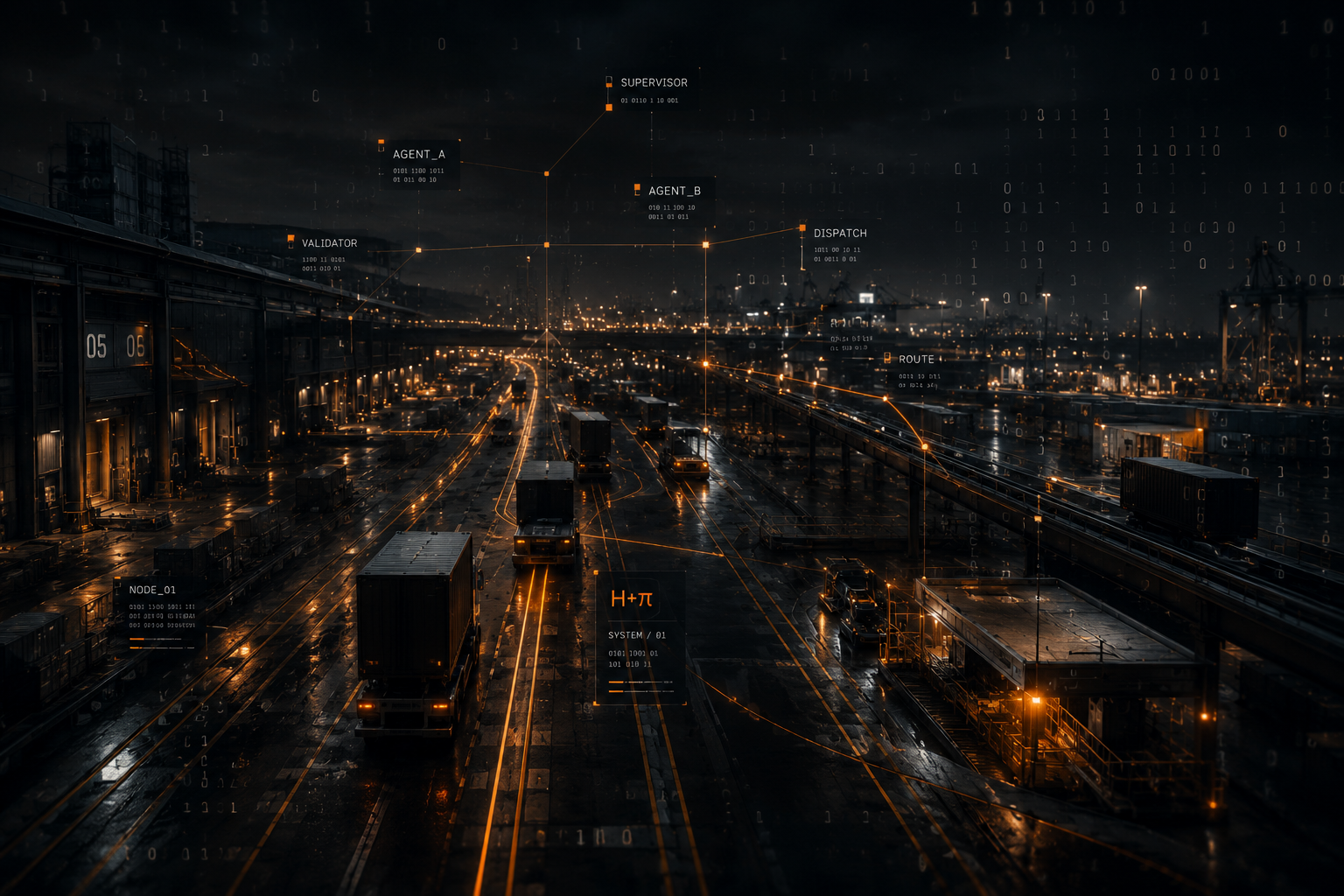
HIRAX formulated a layered multi-agent architecture powered by AURA Core. Rather than relying on a single monolithic scheduler or unconstrained conversational agents, the system decomposes fleet routing into a hierarchy of specialized, bounded agent roles:
Aura Dispatch Arbiter
Maintains global depot objectives, monitors fleet-wide SLA thresholds, and allocates compute resources across regional sub-meshes.
Cluster Route Agents
Autonomous edge workers negotiating local route permutations, vehicle battery windows, and package re-assignments via peer gossip protocols.
Deterministic Gatekeeper
A formal verification layer that algebraically validates route proposals against physical physics, driver hour regulations, and safety invariants before action dispatch.
Asynchronous Event Mesh & Memory Isolation
The system operates over an event-driven telemetry bus. Vehicle telemetry streams into low-latency in-memory state rings. Regional route agents evaluate localized path mutations asynchronously, proposing atomic state diffs to the validation gatekeeper.
End-to-End Dynamic Rerouting Lifecycle
When an unexpected route blockage occurs, the affected vehicle agent triggers a local negotiation event. Neighboring vehicle agents evaluate excess payload capacity within milliseconds, exchanging candidate delivery handoffs through the deterministic validation gate before committing route alterations to drivers.
Simulation Rig & Synthetic Stress Testing
Evaluated against synthetic logistics benchmarks simulating 5,000 active delivery vehicles and 50,000 hourly dispatch events under injected storm disruption cascades.
Demonstrated Engineering Results
Maintained continuous sub-second route adaptation with zero constraint violations across simulated operational stress suites, proving the viability of bounded multi-agent architectures over centralized solvers.
Current Known Constraints
Peer gossip negotiation latency scales with regional mesh density; meshes exceeding 1,000 concurrent agents per cluster require hierarchical partitioning.
Hardware Acceleration & Real-World Pilots
Exploring on-vehicle edge compute nodes for offline-first autonomous dispatch reconciliation during cellular blackouts.